
You Don't Need to Code to Build an AI Agent. You Need a Good Reason.
Apr 16, 2026Every communications professional I talk to right now is somewhere on the same spectrum.
On one end: people who've heard "AI agents" enough times that it's become background noise. On the other: people who've tried to build one, hit a wall of API keys and Python scripts, and quietly decided it wasn't for them.
Both groups are missing the same thing — not better tools, but a clearer starting point.
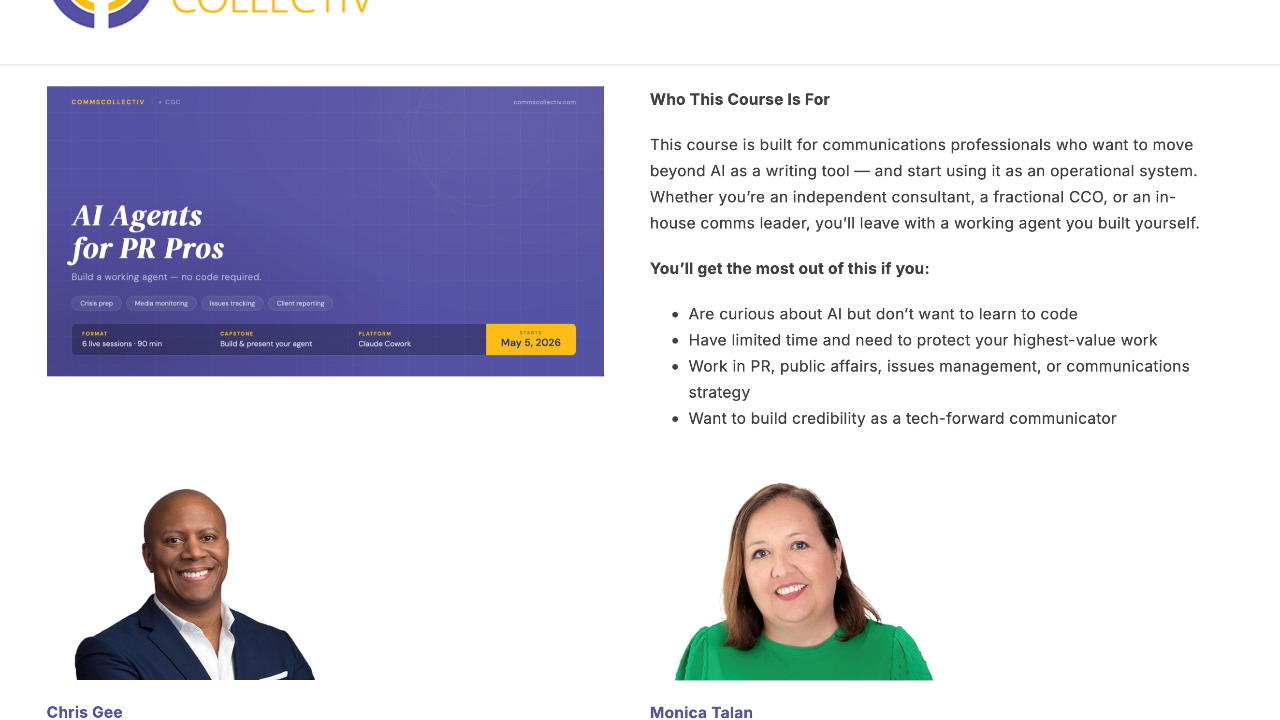
That's what I've spent the last several months working on. And it's why I partnered with CommsCollectiv to build AI Agents for PR Pros, a 6-week cohort program launching May 5.
The Problem With How We Talk About Agents
When the tech industry introduced AI agents to the world, they framed them as digital workers. Autonomous employees who never sleep, never need benefits, and can replace entire headcounts.
Corporate America got excited. Then confused. Then frustrated when reality didn't match the pitch.
Here's how I actually describe agents to clients:
Every job is made up of a stack of discrete tasks. The two or three at the top are the ones that require your judgment, your relationships, your expertise. The rest? They're time-consuming, repetitive, and keeping you from the work that actually matters.
Agents are brilliant at the bottom of that stack. Not because they replace you — but because they clear the path so you can do what only you can do.
For communications professionals, that bottom of the stack looks like: weekly monitoring sweeps, inbox triage, briefing prep, legislative tracking, client status summaries. Work that matters, but doesn't require you specifically to do it at 7am on a Monday.
Why Most Communicators Haven't Built One Yet
The barrier isn't motivation. I've never met a comms pro who didn't want to reclaim time.
The barrier is tooling. Most agent platforms assume a technical background. You're copying API keys, connecting to OpenAI, navigating interfaces built for developers. One wrong step and you're staring at an error message with no idea what went wrong.
That's not a skills gap. That's a design problem.
Claude Cowork solves it. It's a desktop tool that handles the technical infrastructure in the background — you tell it what to do in plain language, and it gets to work. No code. No API setup. Twenty dollars a month.
I started using it seriously a few months ago. Within one weekend of experimenting, I'd downgraded my ChatGPT Pro subscription from $200 a month to $20. The Cowork setup I built now monitors my Otter logs, scans my inbox, surfaces what I've dropped, color-codes by urgency, and drafts follow-up messages ready to send — while I'm on a call.
That's the tool we're building in.
What the Cohort Actually Looks Like
Six sessions. Ninety minutes each. Starting May 5.
We're not doing a survey course. We're not covering every AI tool on the market. We're going deep on one thing: building a working agent that solves a real problem in your practice.
The capstone is the Issues Intelligence Briefing Agent — a customized brief that monitors a topic area you define (legislation, crisis signals, industry news, client sector) and outputs a stakeholder-ready summary on your schedule. Every participant builds their own version and presents it in session six.
Here's how we get there across the six weeks:
Session 1 — Why this matters for communicators specifically. Not content creation — issues management, public affairs, reputation, crisis. The full picture. Plus responsible AI fundamentals before we touch any tool.
Session 2 — Mapping your workflow. Where's the drag? What's the task that eats your Monday morning? That's your build target.
Session 3 — Building your first agent. Trigger, task, output, escalation. We go hands-on in Cowork.
Session 4 — Comms-specific use cases. Crisis prep, issues tracking, client reporting, legislative monitoring. Live demo of a real command center setup.
Session 5 — The credibility stack. Responsible AI, GitHub portfolios, corporate compliance. Because building it is one thing — owning it professionally is another.
Session 6 — Capstone presentations. You built it. You show it. You own it.
Who This Is For
- Independent consultants and fractional pros who want to run leaner without sacrificing quality.
- In-house comms leaders who are expected to do more with the same team size.
- Public affairs professionals tracking legislation across multiple states or markets.
- Anyone who has said "I'd love to learn more about agents" and then never had the time or a clear enough on-ramp.
You don't need a technical background. You need a paid Claude subscription ($20/month) and something you want to automate.
A Note on Timing
We're not early anymore. But we're not late either.
The communicators who build this kind of fluency now — who can design an agent, explain what it does, and show it to a client or a leadership team — are going to have a different kind of credibility in the next 18 months. Not because the technology is impressive, but because they'll have actually used it to solve something real.
That's the gap this course closes.
CommsCollectiv community members get 20% off. Everyone else pays full price. Spots are limited — we keep cohorts small by design.
Register now at commscollectiv.com/ai-agents-for-pr-pros
Questions? Reply to this post or reach out directly. I'm happy to talk through whether it's the right fit for where you are.
GET THE INTELLIGENT COMMUNICATOR
Accelerate Your AI literacy in Just 10 Minutes a Month!
We hate SPAM. We will never sell your information, for any reason.