
I Worked Inside Every Firm in the Burson Story. Here's What I Saw. Part 1 of 3
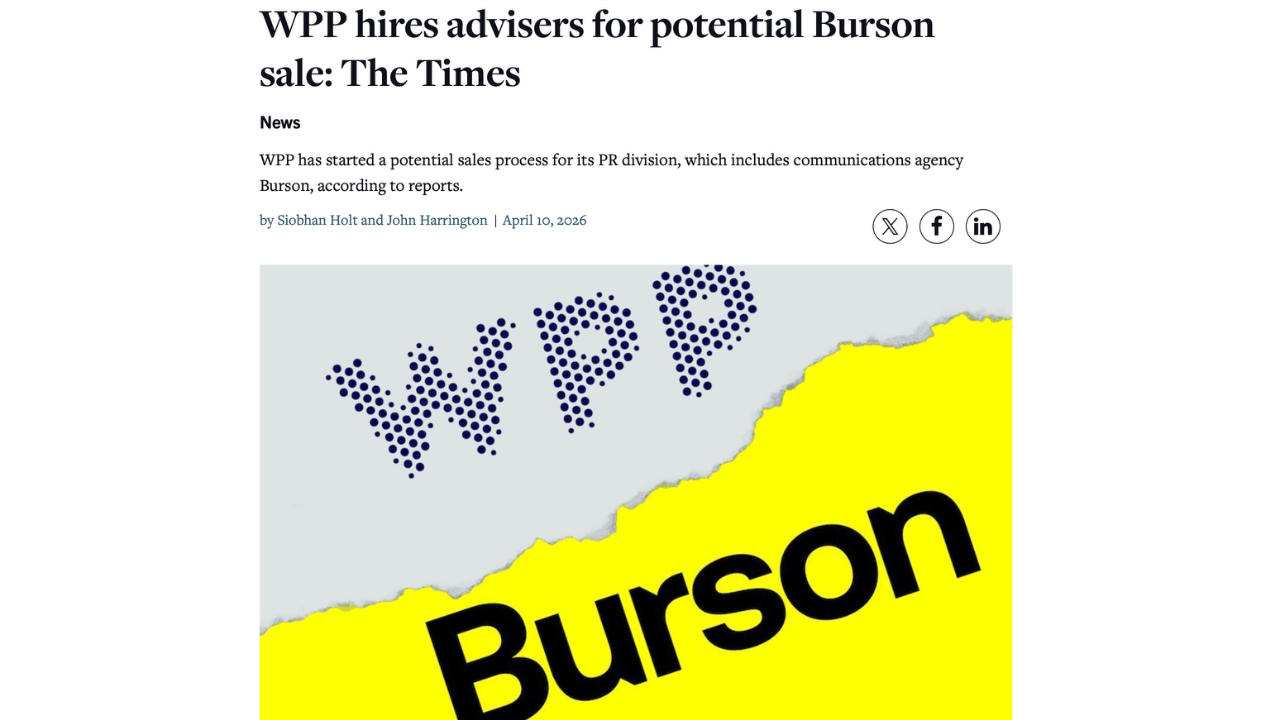
Apr 13, 2026On April 10, 2026, PRWeek reported that WPP had hired Goldman Sachs to explore strategic options for Burson, its global PR arm. Both WPP and Goldman declined to comment. The rumor had been circulating for months. The news itself was not a surprise.
My reaction was.
Because when I read the headline, I didn't think about Cindy Rose, or WPP's 3.4 billion pound debt, or the stock price, or the Elevate28 restructure. I thought about a conference room in 2008 where a senior colleague told me that 20 billion media impressions was a legitimate number to put in a client report. I thought about a training program called First Chair that doesn't exist anymore. I thought about a hallway conversation I had at Burson where someone, in all seriousness, said the best way to get a job there was to currently work at Edelman.
And then I thought about how much of the PR industry I've actually lived inside.
THE RESUME IS THE POINT
I worked at Burson twice. I did a tour at Finsbury during the RLM Finsbury era, when the firm still carried the DNA of Robinson Lerer Montgomery, a New York shop that most comms pros under 40 have never even heard of. I spent three years at Teneo (2012 to 2015) during the period when BC Partners made a significant private equity investment, one of the first PE plays in the PR agency world. I landed at Edelman in 2020, the largest independent PR firm on the planet, and was laid off in the middle of 2023. That's when I started building my own thing.
If you map that resume against the story that broke this week, something unusual happens. Almost every major data point in the current consolidation narrative is a place I used to work.
Burson, the asset WPP just put on the market. Finsbury, whose lineage runs through FGS Global, which WPP sold to KKR in late 2024 for 1.7 billion dollars. Teneo, the firm that showed private equity that PR could be a legitimate asset class. Edelman, the last great independent, still holding the line, still the reference point every PR pro invokes when they want to believe the old model has a future.
I'm not writing this to brag about the stops on my career. I'm writing this because I think I owe the industry a version of this story that only someone with my specific sequence of badge pictures can tell. The commentary I'm reading about the Burson news is being written by reporters who are doing their jobs well and by consultants who are doing their jobs well, and almost none of it has the texture of what this actually felt like from the inside, year by year, firm by firm, meeting by meeting.
So this is Part 1 of a three-part series.
This part is witness testimony. Part 2 will explain the math that nobody wants to talk about, the reason the pyramid model is breaking and why AI is the accelerant nobody planned for. Part 3 will be the prescription, the specific moves I think working comms pros need to start making this week if they want to be relevant in 2031.
Let's start with the part most people don't know about.
2008 WAS THE NEXUS
When I arrived at Burson for my first tour in 2006, it still felt like the old world. I was hired as a director to run the digital creative team, building corporate websites, crisis sites, and interactive work at the moment when that category was just starting to matter. The role was bleeding edge for 2006. The culture I walked into was not.
The culture was collegial. Leaders mentored associates the way a law firm mentors junior lawyers. Training wasn't a PowerPoint. It was in-person, selective, and treated as a genuine investment in the next generation of the firm. There was a program called First Chair for managers and directors. You didn't apply. You were nominated by a manager, selected through a structured process, and pulled into intensive role-play and live coaching over multiple days. It was tied to the firm's leadership pipeline. For managing directors and above, there were off-site weekends with the same depth of investment, the kind of experience that created loyalty and craft transfer that no learning management system has ever replicated.
There were also spot training opportunities. Interview training. Public speaking coaching where they filmed you and sat with you afterward to unpack what you were doing wrong. Apprenticeship, basically, in the classical sense.
THEN 2008 HAPPENED
The Great Recession hit, and the money dried up. The in-person programs got cut. The off-site weekends disappeared. First Chair, as far as I can tell, quietly went away. When I came back to Burson for my second tour years later, nobody was talking about it anymore. Nobody on the floor remembered it. It was gone, and the institutional memory of it was gone with it, replaced by on-demand learning modules that associates could click through on their own time. That's not training. That's a compliance checkbox with a learning theme.
At the same time, something else was happening. The pressure on billability started to become the entire conversation. Billability, for anyone outside the industry, is the percentage of your working hours that gets billed back to a client. If you were a junior person, the target was close to 90%. If you were a senior person, the target was around 50%, because senior people were expected to do new business, manage teams, and run the firm. That math, by the way, is the single most important thing I'm going to tell you in this entire series. Remember it. It's the key to everything that's happening right now. We'll come back to it in Part 2.
The short version is this: the 2008 financial crisis was the first cost-out wave to hit the global PR agency business. Training infrastructure got stripped. Apprenticeship got stripped. The culture that made Burson famous got stripped. What got left in its place was a billability-obsessed production engine that still generated good margins, but no longer produced the next generation of senior talent the way the old model did. The industry made a quiet trade. It gave up craft transfer in exchange for short-term margin protection. Nobody said it out loud. It just happened.
That first cost-out wave never ended. It has been compounding for almost two decades. The Burson sale in 2026 is not a new story. It's the second act of a story that started in 2008, and the second act is where the main character finally runs out of road.
GET THE INTELLIGENT COMMUNICATOR
Accelerate Your AI literacy in Just 10 Minutes a Month!
We hate SPAM. We will never sell your information, for any reason.
